
Weight Stigma
This week was Weight Stigma Awareness Week, an initiative between Dr. Wendy Oliver-Pyatt, co-founder of Within Health and Chevese Turner, founder of the Body Equity Alliance. These two powerhouses came up with the idea to bring together providers, activists, policymakers, and supporters to combat weight stigma and raise eating disorder awareness. The week is entirely free, and includes conversations, virtual educational events, and resources focused on educating and empowering people to challenge the weight stigma in our society. As eating disorder dietitians, we are so grateful for this event, as weight stigma’s roots lie in racism, shame, and discrimination. Weight stigma is often the catalyst for eating disorders, as people believe their body size or shape is the problem, or providers focus so much on weight that a person engages in disordered behaviors in order to get necessary medical care.

What is Weight Stigma?
According to the National Eating Disorders Association, “Weight stigma, also known as weight bias or weight-based discrimination, refers to the negative attitudes, beliefs, stereotypes, and discriminatory behaviors directed towards individuals based on their body weight or size. This form of discrimination is prevalent everywhere and manifests in various settings and in social interactions.
Weight stigma often targets individuals who are deemed to be in higher weight bodies, but it can affect people of all body sizes. Weight bias can increase body dissatisfaction, a leading risk factor in the development of eating disorders. In fact, the best-known environmental contributor to the development of eating disorders is the sociocultural idealization of thinness.”
Why Weight Stigma is Harmful
NEDA has a wonderful definition, but put simply, weight stigma is discrimination against someone based on the size of their body. It is making an assumption about someone’s health because of what they look like. This is especially problematic when thinking about eating disorders, as we discussed in our Eating Disorder Myths and Facts blog, as people with a higher body weight have a 245% greater chance of engaging in disordered eating behaviors compared to people in a clinically normal weight range (4). Why is this? It’s because of weight stigma - patients may be afraid to raise concerns to a provider that may not be taken seriously. Weight stigma is so prevalent in medical settings that someone in a larger body may actually be celebrated for behaviors that would be concerning in a patient in a smaller body. This is despite the fact that less than 6% of people with an eating disorder are medically underweight (2).
At Namaste Nourished, we practice from a Health at Every Size® lens, which approaches healthcare not from a weight loss standpoint, but from an accessible one. (Read more about Health at Every Size® here). Our experience, and the wealth of evidence bears out that approaching healthcare from a weight-inclusive, HAES® perspective allows for better care.
Physical Health is Just One Piece of Wellness
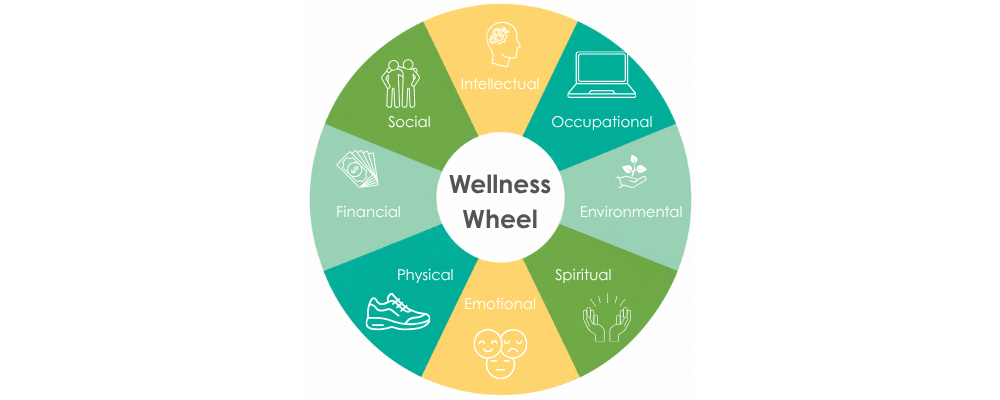
Weight stigma is also damaging, given that someone’s physical health is only a piece of the wellness puzzle. The Wellness Wheel, which was first developed by Dr. Bill Hettler in 1977, and later expanded by Jane Myers, Thomas Sweeney, and Jane Witmer in 1991, is a visual representation of the various elements that go into someone’s overall wellness. Current models show a wheel with eight equal segments, representing all the various elements of health. This includes social, intellectual, occupational, environmental, spiritual, emotional, physical, and financial health.
In our opinion, there is no such thing as “perfect health,” since everyone’s definition of health is variable and based on personal goals. But even if there were such a thing as perfect health, the wellness wheel would be unbalanced if physical health is the only focus. Weight stigma focuses on one specific aspect of a person (and not even the health of that aspect), rather than a holistic, whole-person approach to care.
As eating disorder dietitians, and providers committed to practice evidence-based care, we are thankful for this week’s focus on weight stigma and its harmful effects. Visit weightstigmaawarenessweek for more information or reach out to us today.
Resources
Edwards-Gayfield, P. Weight Stigma. NEDA. https://www.nationaleatingdisorders.org/weight-stigma/
Flament, M. F., Henderson, K., Buchholz, A., Obeid, N., Nguyen, H. N., Birmingham, M., & Goldfield, G. (2015). Weight Status and DSM-5 Diagnoses of Eating Disorders in Adolescents From the Community. Journal of the American Academy of Child and Adolescent Psychiatry, 54(5), 403–411.e2. https://doi.org/10.1016/j.jaac.2015.01.020
Gaudiani, Jennifer L. Sick Enough: A Guide to the Medical Complications of Eating Disorders and Undernutrition. Routledge, 2025.
Ramaswamy, N., & Ramaswamy, N. (2023). Overreliance on BMI and Delayed Care for Patients With Higher BMI and Disordered Eating. AMA Journal of Ethics, 25(7), E540-544. https://doi.org/10.1001/amajethics.2023.540
Weight Stigma Awareness Week. Weight Stigma Awareness Week. https://weightstigmaawarenessweek.org/
Wellness Wheel Assessment. University of New Hampshire. https://extension.unh.edu/health/programs/wellness-wheel-assessment